Two ways of getting income from an MIP(Monthly Income Plan)
We will see two different ways of generating monthly/quarterly income through MIP’s Monthly. One is the regular way of choosing dividend option and the option one is starting Systematic Withdrawal Plan from MIP after an year of buying it . Lets look at both and its pros and cons …
1. Choose dividend option
The good point in this option is that you will start getting the income immediately as company starts declaring the dividends, and you don’t have to take care of taxation issues. However the bad side is that eventually 14% dividend distribution tax would be paid by company and the stability of income will depend on how often dividends are declared by company. If they skip the dividend you will not be getting the income for that month/quarter .
2. Choosing growth option and start SWP (Systematic Withdrawal Plan)
If you use a bit of strategy, you can create a more stable and more tax efficient income by this method. You can choose growth option in MIP and after 1 yr you can start a SWP (systematic withdrawal plan , opposite of SIP) from your MIP to your bank account . What will happen with this option is that you will not have to depend on companies dividend announcement , as its your decision to liquidate a fixed part of your MIP’s, sell it and get the money in you bank account . Also as you are doing it after 1 yr, there wont be any exit load and the profits you get out of it would be Long term capital gains , so you only pay 10% on the profits (assuming you don’t want indexation benefits) , which is 4% lesser than the dividend distribution tax . If you have a large amount of investments in MIPs, then this option can save some tax for you, but if your investments aren’t significant enough, it’s not worth the hassle .
My choice would be to go with option 2 Growth option and start a Systematic Withdrawal Plan after 1 year.
Limited space can still be put to great use with some clever design tricks like making the most of vertical space growing opportunities. Not only are these functionally effective, but tend to be more low maintenance and enhance your garden space visually.
Almost anything can, with a little imagination be turned into a place to grow something in your own backyard.
Even if you've only got a windowsill, you can still grow some lovely grub.
Choose windowsills that get plenty of sun - five hours a day or more during summer preferably.
The wider the sill the better, as you'll be able to get bigger containers onto it. And if it catches the rain as well, that's even better - it'll save on watering later.
The deeper your windowbox, the greater the variety of veg you can grow. Make sure it's properly fixed and supported, as it'll be very heavy once it's full.
A 20cm deep windowbox is fine for salad leaves and 30cm for the Dig In carrots and beans. Very few windowboxes are big enough to suit a courgette plant - they need a lot of room.
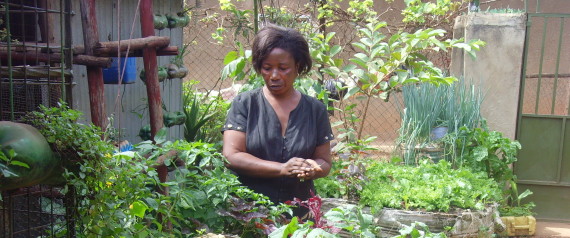
Nakabaale apparently learnt sack farming from her parents who used to practice it at home on a small scale. In fact, growing up she was always told that every woman needs a garden, something that inspired her to set up a sack garden to fit in her small space.
The sacks are not ordinary, at least in regards to size. They are so gigantic with a radius of just over one meter. She has only four of them; exactly what her compound can hold.
Setting Up The Garden
“I started by collecting huge sacks that had been dumped around my neighbourhood. Given that I have always had a poultry house, I was able to compost chicken manure that had accumulated in the coop. This I mixed with black soil to enrich the soil. But I did not just fill the sacks with the soil, I had to place small pebble stones at the middle of the sack, right from bottom to top, then filled the sack with soil leaving the stones erect in the middle,” the mother of three says.
Harriet Nakabaale shows some crops in eggshells that she grows as part of her extended farming in her sack garden.
The stones ensure sufficient water distribution throughout the sacks during watering. In one of the sacks she grows spinach, dodo and carrots. In another sack is a young guava tree right in its centre surrounded by green vegetables. In yet another there are spring onions, celery, tomatoes and spinach. True to her philosophy, size does not matter which is why even in egg shells there are thriving plants.
In order to ensure maximum usage of the sack, she grows some crops on the sides of the bag. “Usually the crops with big roots like carrots go on the top and the sides are reserved for those with small roots like ordinary vegetables. I water my sack garden almost on a daily basis so I have no such a thing as a crop growing season. My garden is ever green, even during the dry season,” she says.
Profitable farming - Rs. 6 Lakh per Acre from Natural Farming (Zero budget farming) Sri Krishnappa Dasappa Gowda has developed this model in 5 acres. He has divided that 5 acres into equal blocks of 36ft X 36ft. In this video, he explains that in each block of 36 ft x 36 ft (which is further divided into four 9ft X 9ft sub-blocks) he is growing around 170 [plants and] trees.
In that he is explaining about the yield he is getting in a 9ft x 9 ft portion of land (one sub-block). He planted 1 Banana tree, 4 Arecanut Trees, 4 Black pepper creepers climbing on Arecanut trees, 2 Coffee plants, 2 Gliricidia trees, 2 Vanilla creepers climbing on Gliricidia trees & 32 Ginger plants in each 9ft X 9ft area.
He says that the Yield from:
(1) 1 Banana Tree - 10 Kg X Rs.20/- = Rs. 200=00
(2) 4 Arecanut Trees - 25 Kg x 4 Trees x Rs.15/- = Rs.1500=00
(3) 2 Vanilla creepers + 2 Gliricidia Trees - 50 gms x 2 trees x Rs.3/- = Rs. 300=00
(4) 4 Black Pepper creepers - 1 Kg x 4 x Rs.400/- = Rs.1600=00
(5) 2 Coffee plants - 2 Kg x 2 Plants x Rs.80/- = Rs. 320=00
(6) 32 Ginger plants - 0.15 kg x 32 x Rs.100/- = (Rs. 480=00) (This income Rs.480/- is utilized for expenses)
Total income from 9ft x 9 ft (Sub- block) land = Rs.3800 = 00
So, for each 36ft x 36ft block (4 Sub-blocks + 1 Coconut tree + 1 Mosambi tree) the total income is approximately Rs.18000 = 00.
Explanation:- income from each 9ft X 9ft sub-block = Rs.15,200/- In addition to these blocks he planted 1 Mosambi (citrus) tree and 1 Coconut Tree in each 36ft X 36ft block and the income from them is Rs.2000/- and Rs.1000/- respectively. So, the total income from each 36ft X 36ft Block is Rs.18,200/- and rounded off to Rs.18,000/-
For 1 acre there are 33 similar blocks like this. So, the total income per acre is Rs.6 Lakh approx. (Rs.18,200/- X 33 blocks = Rs.6,00,600/- and rounded off to 6 Lakhs).
CONCLUSION : He doesn't have any borewell in his farm and he says that his land is a double wet land and mostly it is rainfed, canal water is used very rarely during peak summer. Water consumption is 10% of regular farming. He suggests that all the farmers should adopt similar Natural Farming Methods and grow plants & crops suitable for their local climate and reap money. Wish you all the best .
Five Layer Palekar Models (Model I)
(Mango, Amla, Custard apple, Drumstick, Sapota, Orange, Mosambi, Kinno(vengai tree in Tamil, Bijasal in Hindi, Honne in Kannada), Lemon, Malta(some orange), Guava, Pomegranate)
Five Layer Palekar Models (Model II)
(Coconut, Areca nut, Black Pepper, Coffee, Cocoa, Vanilla, Rubber, Pine apple, Oil Palm, Cashew nut)
Marketing ideas - To sell Organically grown Vegetables, fruits and greens
1)Place a temporary small hut(canopy/stall) in apartments/IT parks/IT establishments etc and sell the organic vegetables 2)Buy a booth at weekly or daily farmers markets or weekly markets like chandi(chandai). 3)Contact restaurants and caterers and sell fresh produce on a weekly or semi-weekly basis. 4)Build a produce delivery service. Offer a box of Organic produce for a consistent price on a weekly basis, and market to busy families and singles.
For instance, design the contents by choosing two fruits and four vegetables every week and charging a set price, such as Rs.50/- per box.
Use a facebook and emails to take orders and list the week's produce contents.
Advertise through local school, temple, church and local newspapers.
5)Contact the online retailers like bigbasket.com for selling your produce
6)Contact the Retail supermarkets to sell your produce in bulk
7)Directy take your produce to some wholesale seller and sell it to him in bulk
8) Sell your organic produce directly to hospitals like Apollo, Ramachandra, MIOT etc
9) Sell your produce directly to College hostels and canteens
10)Sell your produce at nominal price to Ashrams, helping homes and missionaries
Consistency is important when selling produce. Establishing a routine that clients can depend on can lead to repeat and long-term buyers
Once a software engineer now a beekeeper, turns down promotion and onsite job in United States for entrepreneurship!
“I was a software engineer in Wipro Technologies, Bangalore. I resigned my job to do beekeeping at my home town Karur District, Tamil Nadu. I produce the rarest form of uni-floral honey products and sell it online through my own website www.honeykart.com,” says Mr. Krishnamurthy Sanaparatti Palanisamy, Founder.
Mr. Krishnamurthy is a 2007 engineering graduate in communication. He worked with Wipro Technologies as a programmer. After working for two years, he was offered a promotion and onsite job in United States. “That was the day, I took the toughest decision to quit the job, return home, and become an entrepreneur,” he says.
He insists he didn’t leave Wipro but left his IT profession because, “City life didn’t suit me so I came out,” and adds, “Initially I did some share trading business but didn’t gain much and finally decided to invest my money in my own business rather than investing in others.”
Bitten by the entrepreneurship bug Mr. Krishnamurthy did one year vigorous search and then decided to produce and sell honey, “I found that beekeeping is very important for agriculture, horticulture and forestry but it wasn’t practiced properly in Tamil Nadu,” he adds. This was the beginning of his life as a beekeeper.
Honey Kart was established at Aravakuruchi Taluk, Karur District,Tamil Nadu with the capital investment of Rs. 3 lakhs funded by his friends Krishnaraj, Arun and Prabhu.
Business that looks rosy after its profits are revealed surely is full of thorns during its initial start and so was it for this scientific beekeeper. “3 years ago, my first year in beekeeping was very tough. I didn’t even earn a single rupee. I found many problems in bees and was not able to solve it immediately,” he shares.
None of information received from beekeeping experts, whom he met in person help to solve the problems. With a ‘not-to-give-up attitude’ Mr. Krishnamurthy took to internet and contacted beekeepers within and outside India. He gathered lot of tips from internet and steadily solved all the problems in beekeeping one by one during each seasonal change. “Now I have disease free colonies working at its best, which is important to produce high-quality honey,” he adds.
Mr. Krishnamurthy didn’t take the usual route to beekeeping and instead he brought the difference with his innovative skills and developed unifloral honey varieties that were never existing in India. He calls himself a scientific beekeeper because he uses advanced beekeeping technique. “I direct the honey bees to a particular flora and collect honey from same flora in order to produce unifloral honey namely drumstick, coriander, glory lily, mango, sesame, jamun, sunflower, banana, and neem,” he says and adds, “No two unifloral honey will have the same taste, smell, colour and moisture content. For example sunflower honey will be golden yellow while mango honey will be maroon in colour.”
Detailing further he says, “Bees were invented in nature for pollination of plants. It carries pollen from male flower and honey from female flower to their hives, as both these items are their food. After collecting pollen, they visit female flower to collect nectar (honey), and the pollen from the bees’ body is transferred to female flower while it collects honey. Thus pollination happens.”
It is the natural behaviour of the bees not to transfer pollen from male flower of one plant variety to female flower of other plant variety and vice versa. “I use this behaviour of bees to collect honey from same flora by keeping the hives in the vast cultivation of single flora,” he says and adds, “When sufficient honey (bee flora) is made available from a single floral variety plants, the bees will not go to other flora until the nectar secretion of the existing flower is stopped.” This helps in producing unifloral honey.
Special benefit is, “When ayurvedic medicines are taken along with the unifloral honey it gives best results. Most of my customers are taking ayurvedic medicines and are quite happy with the outcomes,” he claims. Other than unifloral honey variants Mr. Krishnamurthy’s another innovation is ‘honey for babies less than 12 months age’. He informs, “This honey is collected from new combs and extra care is taken for processing; hence it is resistant to all sorts of allergies or side effects in babies.” Honey for Babies can be made from any flowering plants with only one requisite that the honey comb should be newly constructed by the bees. “This honey is obtained in the beginning of honey flow season where the bees make new combs for the next one year,” he informs.
Honey production depends on the bees’ strength. “I will collect 6kgs in 6 days from one hive provided enough bee flora is available. The raw honey collected is processed later. Usually Mr. Krishnamurthy processes 200 kg/day. He stores the processed honey in cans and based on orders the honey is packed in glass or food grade pet bottles. Beekeeper recommends to the consumers to store honey in air-tight jars. Shelf life of packed honey bottles is 5 years while once opened it stays for 2 years. Commonly honey is packed in 250 gms bottles but courier packing (for home delivery) is completely different.
All honey products are sold through company’s website www.honeykart.com and Facebook page www.facebook.com/honeykart. Website provides details on health benefits of each unifloral honey. Approximate cost of unifloral honey is Rs. 716/kg. Honey for Babies is priced more. Buyers can even opt for home delivery option within India. “Most of customers are from Bangalore and Chennai. Due to my honey quality, 90% of buyers become regular customers,” he informs.
It is an established fact that beekeeping helps in crop yield increase (approximately by 30%) through pollination. Hence Mr. Krishnamurthy’s beekeeping venture is turning out as a boon for farmers in Tamil Nadu. He shares, “Many farmers from various districts in Tamil Nadu call me to place my bee hives in their farm for pollination purpose. During flowering season, I keep my beehives in their agriculture farm for free of cost, and once the flowering season is finished I bring back my hives after harvesting honey. I am benefited by honey produce and farmers by the extra 30% crop yield. It is a win-win business for both of us.” Technical training on beekeeping is also provided on nominal charges.
He plans to double the honey production this year and adds, “South India is famous for spices and herbs and most of these are flower producing plants. I want to try my hands on these flavours as this cannot be produced elsewhere in the world. I want to explore our nature.”
Following his heart Mr. Krishnamurthy has attained success and now enjoys stress-free life. Being an entrepreneur himself he strongly feels the country needs power of entrepreneurship. After seeing his success and attitude he is invited by colleges to encourage youth. “While giving lectures on “Entrepreneurship” to college students I noticed that the students love to listen from an entrepreneur himself and this indirectly encourages me as well,” he shares and concludes, “I have to sketch down a plan to earn enormously through genuine beekeeping practice because I need to become a role model to start-up entrepreneurs that a lot can be earned when you become an entrepreneur!”
Contact details- Honey Kart Scientific Beekeeping Farms Aravakuruchi, Pin:639201 Karur-district, Tamil Nadu, India Mobile: 91503 70525 Email: honeykart@hotmail.com Website: www.honeykart.com, www.facebook.com/honeykart
ஒருங்கிணைந்த ஊட்டச்சத்து நிர்வாகம் - பசுந்தாள் உரங்கள்
ஒருங்கிணைந்த ஊட்டச்சத்து நிர்வாகமானது மண்ணில் இருக்கும் இயற்கை ஊட்டங்களை பயிர் சாகுபடிக்கு பயன்படுத்திக் கொள்ள ஊக்குவிக்கிறது. பயிரின் ஊட்டச்சத்து தேவையையும், இயற்கை மற்றும் ரசாயன ஆதாரங்களின் மூலம் ஊட்டச்சத்துக்களையும் ஒருங்கிணைத்து பயிர்களுக்கு சமச்சீர் ஊட்டத்தை அளிக்கிறது. இயற்கையோடு ஒன்றிய, சுற்றுச்சூழலைப் பாதுகாக்கக் கூடிய உன்னத உர உபயோக வழிமுறை தான் ஒருங்கிணைந்த ஊட்டச்சத்து நிர்வாகமாகும்.
"மண் வளத்தைப் பேணிக் காக்க மட்குத் தன்மையை அதிகரிப்பதாகும். அதிக மட்கும் தன்மையுள்ள மண் மிகுந்த வளமான மண்ணாகவும், ஈரம் காக்கும் தன்மையுடையதாகவும், பயிர் வளர்ச்சியை ஊக்குவிக்கும் நுண்ணுயிரிகளை பெருக்கும் தன்மையுடையதாகவும் இருக்கும். இத்தகைய மண்ணில் பயிரிடப்படும் பயிர்கள் முழு உற்பத்தித் திறனை வெளிக்கொணர்வதாக இருக்கும்.
மண்ணின் மட்குத் தன்மையை பசுந்தாள் உரப் பயிர்களை நிலத்தில் விதைத்து பூக்கும் பருவத்தில் மடக்கி உழுவதன் மூலம், பசுந்தழைகள், தொழு உரம், மண் புழு உரம், பயிர்க் கழிவுகள் மற்றும் கால்நடைக் கழிவுகள் பயிர் உற்பத்திக்கு பயன்படுத்துவதன் மூலமும் அதிகரிக்கலாம்.
பசுந்தாள் உரங்களை இடும்பொழுது பயிர்களுக்குத் தேவையான சத்துக்களை அளிப்பது மட்டுமன்றி மண் வளம், கட்டமைப்பை மேம்படுத்தி மண்ணில் உள்ள நுண்ணுயிரிகளின் பெருக்கத்துக்கும் வழிவகுக்கிறது.
சணப்பை, தக்கைப் பூண்டு, பில்லிபெசரா, சீமை அகத்தி, கொளிஞ்சி போன்ற பசுந்தாள் உரப் பயிர்களை மண்ணில் விதைத்து, பூக்கும் பருவத்தில் மடக்கி உழ வேண்டும். இதனால், மண்ணில் தழைச்சத்து சேர்க்கப்படும் அளவு குறைவாக இருந்தாலும் தொடர் பயன்பாட்டின்போது மண்வளம் பெரிதும் மேம்படுத்தப்படுகிறது.
விவசாயிகளால் பெருமளவில் பயன்படுத்தப்படும் இயற்கை இடுபொருள் தொழு உரம் கால்நடைகளின் சாணம், தீவன மிச்சங்கள், வைக்கோல் மற்றும் இதர பயிர்க் கழிவுகளுடன் நன்கு மட்க வைக்கப்பட்டு மண்ணில் இடுவதால் பயிர் விளைச்சல் மற்றும் மண்ணின் தன்மை மேம்படுத்தப்படுகிறது.
நன்கு மட்கிய தொழு உரத்தை பயிர் விதைப்பிற்கு மூன்று வாரங்களுக்கு முன் மண்ணில் இட்டு நன்கு உழவு செய்வது உள்ளிட்டவைகள் மூலம் மண் வளம் பாதிக்காமல் பயிர்களுக்கு கிடைக்கும்.
Known commonly as gliricidia or madre tree, Gliricidia sepium is well known in plantation
agriculture as a shade tree. Therefore, it is also called the Mother of Cocoa. It is a nitrogen-fixing tree
that is native to Central and South America. Gliricidia was introduced to Sri Lanka from West Indies
and later to India.
Tree.
Gliricidia is a small fast growing, deciduous, thornless tree. Its short trunk is covered with soft
gray bark marked by longitudinal cracks. It grows up to 10 m height. It has an open crown and a trunk
of less than 30 cm diameter.
Distribution.
It is grown for green manure in Maharashtra, Tamil Nadu, Karnataka and Kerala. It is
widely planted on farm bunds, backyards, and as live fencing.
Soil and Climate.
Gliricidia prefers deep, rich, well-drained soils. It can be grown up to an elevation of
1000 m, but does not tolerate frost. It is a fast-growing species, especially in warm and humid climate.
Propagation.
It is propagated by seed or cuttings. The easiest method is to use poles of about 2.0 m
length, which regenerate readily and grow into a tree within a short period. Removal of such poles also
helps keep the tree in proper shape. Seeds can be sown directly or in polybags and raised in a nursery
for transplanting.
Important uses:
Green manure.
Gliricidia enhances soil organic matter when green foliage and dry leaf litter are
incorporated. Being a nitrogen fixer, the biomass of gliricidia is a rich source of nitrogen. During dry
and cold seasons, it sheds its leaves and thereby conserves precious soil moisture. It can be grown
along the boundaries of the field and the green matter per ha annually. Its essential nutrient
composition is 2.9% N, 0.5% P2O5 and 2.8% K2O.
Wood and fuel.
Wood finishes smoothly and is suitable for making small articles, agricultural
implements and tool handles. Wood is highly resistant to termites and decay. It is also used for ports
and heavy construction. It is a good fuel wood with a calorific value of 4,900 k. cal per kg. Gliricidia
produces ample branch wood as it coppices easily.
Ornamental value.
The tree produces dense masses of attractive white or pink flowers. The flowers
are a good source of forage for bees. The flowers appear during January March when the tree is
leafless. It can be grown along paths of parks, gardens and avenues. It can also be pruned to a height
of 2.0 m and maintained as a hedge.
Shade.
Gliricidia is traditionally used as a shade tree for plantation crops and as a support for pepper
and vanilla.
Fodder.
Leaves of gliricidia contain more than 20% crude protein and are nutritious for cattle. But
livestock not conditioned to it may not readily eat it. In such situations, wilting the leaf may be helpful.
Other uses.
The roots, bark and seeds are poisonous. Juice of the leaves is used for treating
centipede bite. Flowers and seeds are used as rat poison. Powdered seeds, leaves and bark
mixed with rice are used for controlling storage pests.
The species suitable for live fence should be thorny, inedible and non-browsable for cattle and goats, hardy and relatively maintenance-free (other than pruning / lopping), adaptable to the local conditions, fast-growing and producing something that can yield some revenue.
The primary purpose of live fences is to control the movement of animals and people; however, they have proven to be extremely diverse, low risk systems that provide farmers with numerous benefits. Besides their main function living fences can provide fuel wood, fodder and food, act as wind breaks or enrich the soil, depending on the species used.
A live fence should ideally be planted just before the monsoons and watered regularly after the rainy season is over to ensure optimum growth. Usually thorny plants are grown to make a live fence. For example bushes such as agave and cactus, creepers, and small shrubs (perennial bushes) are the most sought after ones. Besides, trees such as subabul and Gliricidia can also be planted as live fence.
Often trees in living fences are allowed to grow to larger sizes than with hedges. A genus of particular importance as living fence is Gliricidia which can serve both as fences and as sources of fuel wood and fodder.
AGAVE -sisal(நீலக்கத்தாழை- Nīlakkattāḻai)
Among the under-exploited resources, ‘Agave’ – a fibre yielding drought tolerant plant is one which can prosper the life of the dry land farmers without any risk. Agave is a short stemmed plant bearing a rosette of long erect pointed fleshy leaves. The sharp spines of the sisal leaves may make this type of hedge unsuitable for use with livestock. Agave is noted for its strong, coarse fibre, superior too and more flexible than Manila hemp. It is widely used for making ropes, cordage, twine, fishing nets, door mats and rugs and the short fibres are used for making mops, brushes.
The waste material left after decorticating the leaves is used for making craft paper and paper boards. The fibres also contain about 73-78% of lignified form of cellulose. Apart from these wax from agave wastes and Hecogenin acetate a steroid useful for the pharmaceutical industry in India is obtained from agave juice.
In the border, a trench with a width of 30 cms may be dug and the soil excavated should be used to make raised bed at the inner side of trench. The agave saplings are planted at a space of 45 cms in pits of 20 cm3. Planting is usually carried out during the rainy seasons for better establishment otherwise initial watering is quite essential for establishment.
Gliricidia sepium is a common live fence post species in Western Ghats and in other tropical areas. Large stem cuttings root with relative ease, and it has multiple uses such as a forage and green manure. Establish a live fence by planting a few large (about 1 mtr tall) stakes on the border with spacing of 2 ft inside the row in combination with Agave. These takes normally take root within a month or so. Allow the shoots to grow for 6 to 10 months before cutting them back. After the first pruning, prunings can be carried out every 4 to 8 months, or seasonally. Larger prunings result in woody sprouts that are suitable for use as further stakes. In this way live stakes can be multiplied for use as living fence posts within a year or two after establishing the first live fence posts. The combination of Agave Sisal and Gliricidia is suggested as live fence. When established, these natural barriers can prevent the passage of livestock and deter both animal and human trespassers from entering the farm.
The cost of establishment of live fence is very minimal. A 10 ft (3 mtrs.) long stretch will approximately cost around Rs.70 – 80.
Thus a perimeter of 3000 ft. (10 Acres) would cost approximately around Rs. 25,000 as against several thousands with other alternatives.